Understanding BMI and the Method Used to Work It Out
Imagine stepping onto a weighing scale and seeing the number 68 kilograms. Does your body weight fall within a suitable range for your height?
The answer depends on more than the number displayed on the scale.
A person who weighs 68 kilograms at a height of 150 centimeters has a different weight-to-height relationship from someone who weighs the same amount at 180 centimeters.
This is the basic idea behind Body Mass Index, commonly known as BMI.
BMI is a mathematical measurement used to compare body weight with height. It is widely used in healthcare settings, research, and health-related calculators because it provides a quick way to screen weight status.
However, BMI is not a complete picture of health. Understanding both its calculation and its limitations is essential.
In this article, we will explore what BMI means, how it is calculated, how to understand BMI categories, and why the result should be considered alongside other health information.
What Does BMI Actually Measure?
BMI stands for Body Mass Index.
It expresses body weight relative to the square of a person's height.
The measurement is useful because weight alone does not account for differences in height.
For example, two adults may each weigh 80 kilograms. If one is 160 centimeters tall and the other is 185 centimeters tall, their calculated BMI values will be different.
BMI provides a standardized way to compare these measurements.
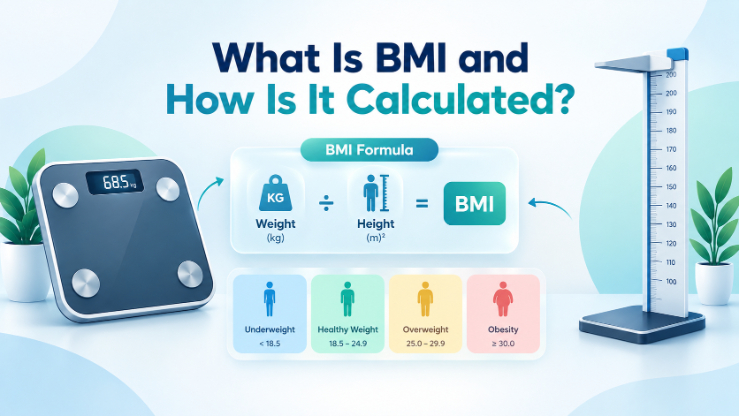
For adults, the result is commonly compared with categories such as underweight, healthy weight, overweight, and obesity.
These categories are intended for screening, not for making a diagnosis.
A person's BMI cannot tell you their exact body-fat percentage, nutritional status, strength, or metabolic health.
It is one measurement that becomes more meaningful when considered alongside other information.
Why Is Height Squared in the BMI Formula?
Beginners may find it confusing that the formula requires multiplying height by itself.
Why not simply divide weight by height?
The BMI formula uses the square of height to create a standardized weight-for-height index that can be applied across a wide range of adult heights.
To square a number, multiply it by itself.
If a person is 1.70 meters tall:
1.70 × 1.70 = 2.89
That number becomes the denominator in the BMI formula.
The person's body weight is then divided by 2.89.
Although BMI does not perfectly account for body proportions, this mathematical approach makes height an important part of the calculation rather than judging everyone by weight alone.
The BMI Calculation Formula
The standard metric formula is:
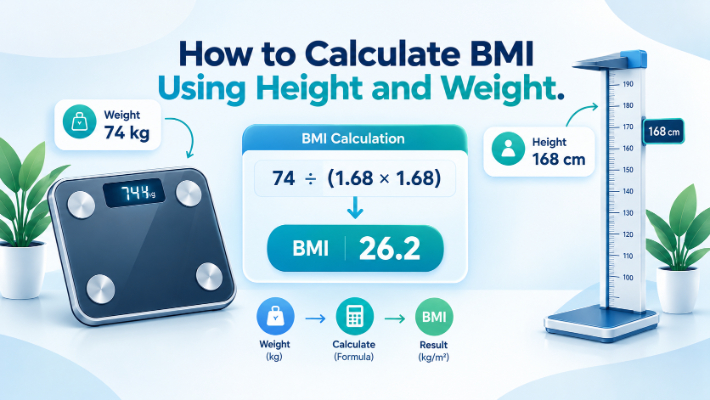
BMI = Weight in kilograms ÷ (Height in meters × Height in meters)
You can also write it as:
BMI = Weight (kg) ÷ Height (m)²
Three measurements or calculations are involved:
Identify your weight in kilograms.
Convert your height into meters and square it.
Divide the person's weight by the height value multiplied by itself.
The resulting BMI is expressed in kilograms per square meter, or kg/m².
You do not need specialized mathematical knowledge to calculate it. A basic calculator is sufficient.
BMI Calculation Example Using Kilograms and Centimeters
Let's work through a realistic example.
Suppose someone has the following measurements:
Weight: 68 kilograms
Height: 172 centimeters
Step 1: Convert the Height
Since the formula requires meters, divide the height in centimeters by 100.
172 ÷ 100 = 1.72 meters
Step 2: Square the Height
Multiply 1.72 by itself.
1.72 × 1.72 = 2.9584
Step 3: Divide the Weight
Now divide 68 by 2.9584.
68 ÷ 2.9584 ≈ 22.99
Final BMI Result
BMI ≈ 23.0 kg/m²
According to standard adult BMI categories, this result falls within the healthy-weight range.
However, someone with this BMI might still have health factors that require attention. BMI is only one screening measure.
How to Calculate BMI in Pounds and Inches
BMI can also be calculated using imperial measurements.
When weight is recorded in pounds and height in inches, the formula is:
BMI = (Weight in pounds × 703) ÷ Height in inches²
The number 703 is a conversion factor.
For example, consider someone who weighs 165 pounds and is 5 feet 8 inches tall.
First, convert their height into inches.
5 feet = 60 inches
60 + 8 = 68 inches
Next, square the height:
68 × 68 = 4,624
Multiply the weight by 703:
165 × 703 = 115,995
Finally:
115,995 ÷ 4,624 ≈ 25.1
BMI ≈ 25.1 kg/m²
Under standard adult classifications, this falls just within the overweight range.
Remember that a result near a category boundary should not be overinterpreted, especially when measurements have been rounded.
For example, a BMI of 24.8 falls within the standard healthy-weight category, while 25.2 falls within the overweight category.
That does not mean a small difference across the boundary suddenly changes someone's overall health.
The result needs to be understood in context.
How Two People With the Same Weight Can Have Different BMI Values
BMI becomes easier to understand when you compare people of different heights.
Imagine two adults who both weigh 80 kilograms.
The first person is 160 centimeters tall.
Their BMI is:
80 ÷ (1.60 × 1.60) = 31.25
Rounded to one decimal place:
BMI = 31.3
The second person is 185 centimeters tall.
Their BMI is:
80 ÷ (1.85 × 1.85) ≈ 23.4
BMI = 23.4
Although both people weigh the same, their BMI results fall into different standard adult categories.
This example demonstrates why height is essential when calculating BMI.
It also shows why a weighing scale alone cannot provide the same information.
What Does a Healthy BMI Mean?
The term "healthy BMI" can sometimes create misunderstandings.
For adults, a BMI between 18.5 and less than 25 is generally classified as healthy weight under standard guidelines.
However, being within this range does not guarantee that every aspect of a person's health is normal.
Blood pressure, cholesterol, blood sugar, sleep, physical activity, and medical history can all matter.
Similarly, having a BMI outside the standard range does not automatically establish that someone has a particular disease.
BMI provides a reason to consider further information, not a complete medical conclusion.
Healthcare professionals may interpret the result differently depending on individual circumstances.
Why BMI Cannot Tell the Difference Between Muscle and Fat
One of BMI's best-known limitations is that it does not distinguish between different types of body tissue.
Muscle contributes to total body weight, just as fat, bones, and other tissues do.
Imagine a strength-trained athlete with substantial muscle mass.
Their body weight may be relatively high compared with their height.
As a result, the BMI calculation might place them in an overweight category even though BMI does not establish their body-fat percentage.
The opposite can also occur.
Someone with a BMI in the standard healthy-weight range may have relatively low muscle mass or other health concerns.
This is why BMI should not be confused with body composition.
BMI Calculator
Calculate BMI and understand your BMI category.
Is BMI Interpreted Differently for South Asian Adults?
BMI-related health risks do not always appear at identical values across population groups.
Some people with South Asian backgrounds may experience increased metabolic health risks at lower BMI values than those reflected by standard international adult categories.
For this reason, UK NICE guidance recommends lower practical BMI thresholds for certain ethnic groups, including South Asian populations.
These include:
Overweight: BMI 23 to 27.4
Obesity: BMI 27.5 or higher
These thresholds provide additional context for assessing health risk.
They do not replace an individualized assessment, and different healthcare systems may use different guidelines.
People should follow the clinical recommendations relevant to their circumstances.
How Is BMI Used for Children and Teenagers?
Calculating BMI for a child uses the same mathematical formula, but interpreting the result is different.
Children and teenagers are still developing.
Their body composition and growth patterns can change considerably with age.
For this reason, the US CDC uses BMI-for-age percentiles for children and teenagers aged 2 through 19.
The standard categories are:
| BMI-for-Age Percentile | Category |
|---|---|
| Below 5th percentile | Underweight |
| 5th to below 85th percentile | Healthy weight |
| 85th to below 95th percentile | Overweight |
| 95th percentile or higher | Obesity |
A BMI percentile compares a child's result with a reference population of children of the same age and sex.
An ordinary adult BMI chart should therefore not be used to classify a child's weight status.
For concerns about growth or development, a qualified healthcare professional can interpret the measurements appropriately.
What About BMI During Pregnancy or Older Age?
BMI also requires additional interpretation in certain life stages.
During pregnancy, body weight changes for reasons that are not reflected adequately by ordinary adult BMI categories.
Healthcare professionals may consider pre-pregnancy BMI when discussing pregnancy-related care.
Older adults can experience changes in muscle mass and body composition, making BMI less informative when used alone.
Someone with a high level of muscle mass may also need a different type of assessment.
These examples reinforce the idea that BMI should be interpreted according to the person, not merely the number.
What Other Measurements Can Complement BMI?
BMI is useful because it is simple, but it cannot answer every question about health.
Other measurements may provide additional information.
Waist Circumference
Waist circumference can help assess abdominal size, which may be relevant to certain health risks.
Waist-to-Height Ratio
This measurement compares waist circumference with height and can provide information about central body-fat distribution.
Blood Pressure
Blood pressure is an important cardiovascular measurement that BMI does not reveal.
Blood Tests
Measurements such as blood glucose and cholesterol can provide information that is not available from height and weight alone.
A clinician may consider these factors together when evaluating overall health.
How to Use an Online BMI Calculator Correctly
An online BMI calculator can perform the arithmetic in seconds.
A typical calculator asks for height and weight.
Some also let you choose between metric and imperial units.
To obtain a reliable result:
Measure your height and weight as accurately as practical.
Choose the correct units.
Enter the measurements into the calculator.
Check that the numbers have been entered correctly.
Review the BMI value and the explanation of its category.
The calculation itself is straightforward, but the interpretation should be appropriate for the person's age and situation.
Do not treat an automatically generated category as a medical diagnosis.
Common Mistakes That Produce Incorrect BMI Results
A few simple errors can lead to misleading BMI numbers.
Entering height in centimeters instead of meters: The standard metric formula uses meters.
Forgetting to square height: Dividing weight by height alone does not produce BMI.
Mixing pounds and kilograms: Choose the formula that matches the measurement units.
Rounding too early: Keep enough decimal places during the calculation, then round the final result.
Using adult categories for children: Children's BMI values require age- and sex-specific interpretation.
Assuming BMI measures body fat directly: It measures weight relative to height.
Correcting these mistakes can improve the accuracy of the calculation.
Frequently Asked Questions
What is BMI in simple words?
BMI is a number that compares body weight with height. It is commonly used to screen weight status, particularly in adults.
How do you calculate BMI without a calculator?
Multiply your height in meters by itself, then divide your weight in kilograms by the result.
What is the BMI formula for kilograms and centimeters?
You can use:
BMI = Weight (kg) ÷ [Height (cm) ÷ 100]²
Is BMI the same as body-fat percentage?
No. BMI does not directly calculate how much of your body weight consists of fat.
Does age affect BMI?
The mathematical formula remains the same, but interpretation differs for children and teenagers. Age and other factors can also matter in adult health assessments.
Can a muscular person have a high BMI?
Yes. A person with substantial muscle mass may have a high BMI because the calculation does not distinguish muscle from fat.
Is BMI enough to determine whether someone is healthy?
No. BMI is only one screening measurement. Overall health assessment may also involve medical history, clinical measurements, and other factors.
Why do BMI calculators sometimes show slightly different answers?
Small differences can result from rounding, measurement conversions, or how a calculator displays decimal places.
Final Thoughts
BMI is a convenient measurement that helps explain how body weight relates to height.
The formula is simple: divide weight in kilograms by the square of height in meters.
Once calculated, the result can be compared with standard adult screening categories.
However, BMI has clear limitations.
It cannot directly measure body fat, muscle mass, cardiovascular fitness, or overall health.
Its interpretation may also differ for children, older adults, pregnant individuals, and certain population groups.
The most useful way to understand BMI is as a starting point for learning about weight-related health information rather than a final judgment about someone's body.
Knowing how BMI works—and where its limitations begin—helps you interpret the result more accurately and responsibly.
Disclaimer: This article is for general educational purposes. BMI is a screening tool and should not replace professional medical assessment or advice.