Finding Your BMI Through Two Essential Body Measurements
A weighing scale gives you one number. A height measurement gives you another. Applying the appropriate equation to your height and weight gives you a numerical measure known as BMI.
However, looking at height or weight separately does not provide the full picture.
Consider a person whose latest measurements show a weight of 73 kg and a height of 173 cm. They enter both numbers into a BMI calculator and receive a result of 24.4.
Where did that number come from?How does a BMI score differ from the number on a scale, and what can you do to check your calculation?
Understanding the mathematics behind BMI allows you to make sense of your score and recognize inaccuracies in the calculation.
The calculation itself takes less than a minute, but there are several details that can affect its accuracy, including measurement units, decimal places, and the correct use of height.
This guide shows you how to calculate BMI using height and weight, verify the answer yourself, and understand what the final number can—and cannot—tell you.
Begin With Your Height and Weight Before Checking BMI Categories
Before looking at BMI categories or interpreting any result, begin with the measurements.
You need your height and your weight.
For example:
Weight: 73 kilograms
Height: 173 centimeters
Although height and weight are easy to measure, they must be expressed in the correct units before applying the BMI equation.
Weight is commonly entered in kilograms, while height needs to be expressed in meters when using the standard metric formula.
If your height measures 173 centimeters, express it as 1.73 meters before entering it into the metric equation.
Once the measurements are ready, the BMI calculation becomes a simple division problem.
The Mathematical Rule Behind BMI
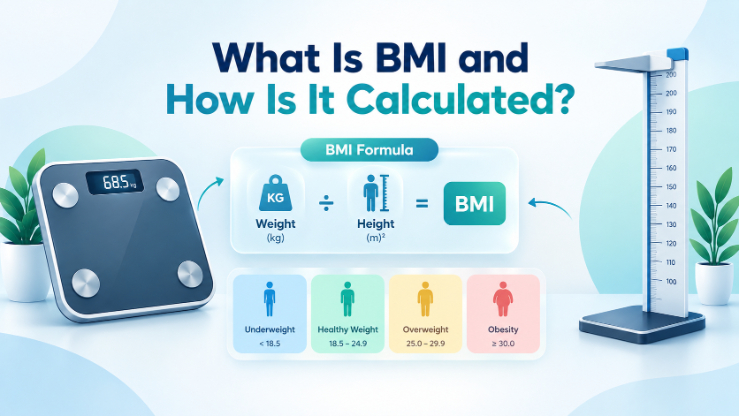
The formula is:
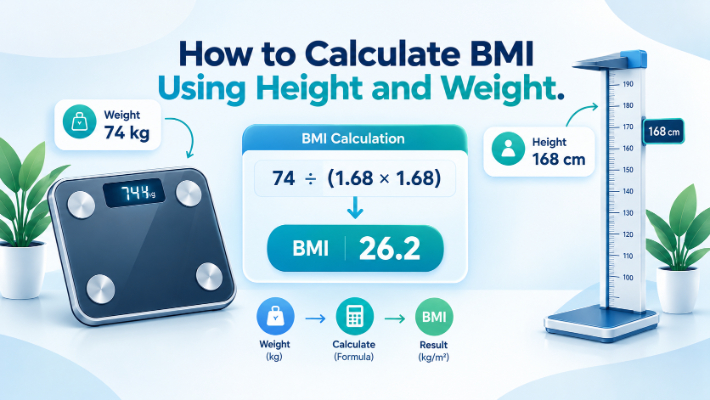
BMI = Weight in kilograms ÷ (Height in meters × Height in meters)
In mathematical notation:
BMI = kg / m²
The small ² symbol means that height must be multiplied by itself.
For example:
1.73 × 1.73 = 2.9929
That result is the number you divide the weight by.
One important detail is the order of operations. You must square the height before dividing the weight.
If you divide weight by height without squaring it, you have not calculated BMI.
Follow a Complete BMI Calculation From Beginning to End
Now consider our example again: an individual weighing 73 kg with a height of 1.73 m.
Instead of simply entering these figures into a website, we'll work through the calculation manually.
First, Prepare the Height
Convert 173 centimeters to meters.
173 ÷ 100 = 1.73
The height is now 1.73 meters.
Next, Multiply the Height by Itself
1.73 × 1.73 = 2.9929
Keep this number without rounding it yet.
Now Use the Weight
Divide 73 by 2.9929.
73 ÷ 2.9929 = 24.390...
Finally, Round the Answer
Rounded to one decimal place:
BMI = 24.4 kg/m²
The calculation is complete.
If an online BMI calculator receives the same measurements and uses the standard formula, it should produce approximately the same value.
A Shortcut When Your Height Is in Centimeters
Converting centimeters to meters takes only a simple adjustment, and BMI can also be calculated using imperial measurements.
If your height is already written in centimeters, use:
BMI = Weight (kg) × 10,000 ÷ Height (cm)²
Why does this formula contain 10,000?
There are 100 centimeters in one meter. Since the formula squares the height measurement, converting centimeters to meters affects the calculation by a factor of \(100 \times 100\).
That gives 10,000.
Using our example:
Weight = 73 kilograms
Height = 173 centimeters
First:
173 × 173 = 29,929
Then:
73 × 10,000 = 730,000
Finally:
730,000 ÷ 29,929 ≈ 24.4
The result matches the previous calculation.
This shortcut is useful if you frequently work with height measurements recorded in centimeters.
What if You Know Your Height in Feet and Inches?
People do not always record their measurements in the same system.
You might know that you are 5 feet 4 inches tall and weigh 143 pounds, for example.
To calculate BMI using pounds and inches, use:
BMI = (Body Weight in Pounds × 703) ÷ (Height in Inches × Height in Inches)
For imperial measurements, the BMI formula multiplies weight in pounds by 703 before dividing by height in inches squared.
Let's calculate the result.
Convert the Height Into Inches
Five feet equals 60 inches.
Add four more inches:
60 + 4 = 64 inches
Square the Height
64 × 64 = 4,096
Multiply Weight by 703
143 × 703 = 100,529
Divide to Calculate BMI
100,529 ÷ 4,096 ≈ 24.54
Rounded to one decimal place:
BMI = 24.5 kg/m²
This approach is helpful when you do not want to convert pounds into kilograms or inches into meters.
Check that your chosen equation is compatible with the units recorded for both height and weight before working out the result.
How to Review Your BMI Calculation for Possible Mistakes
After calculating BMI, it is worth checking the result before interpreting it.
Imagine you enter a height of 173 centimeters and a weight of 73 kilograms, but the calculator gives you a BMI of 243.9.
That should immediately raise a question.
An incorrect BMI value can stem from using inconsistent units, recording a measurement with the wrong decimal placement, or making an error during the calculation.
Here are three useful checks.
Verify your measurements. When applying the metric equation, make sure your body weight is recorded in kilograms.
Check the height conversion. A height of 173 centimeters equals 1.73 meters, not 17.3 meters.
Check the squared number. For a height of 1.73 meters, the squared result should be 2.9929.
After confirming the measurements and units, divide the weight by the squared height to obtain the BMI result.
Understanding the calculation gives you a way to identify errors instead of trusting every result automatically.
How Can an Incorrect Height Measurement Influence Your BMI?
Yes. Even a minor height measurement error can influence the final BMI calculation, which is why accurate measurements matter.
BMI depends on height squared, so inaccurate height measurements can noticeably affect the final value.
Consider an adult who weighs 73 kilograms.
At 173 centimeters:
BMI ≈ 24.4
Now suppose their height is mistakenly entered as 170 centimeters.
The calculation becomes:
73 ÷ (1.70 × 1.70)
The result is:
BMI ≈ 25.3
That is a difference of approximately 0.9 BMI units, even though the weight has not changed.
The example shows why accurate measurement matters, particularly when a result is close to a category boundary.
It does not mean the person's health changed because a different height was entered.
The body stayed the same. Only the calculation changed.
BMI Examples You Can Use to Practice
If you want to become comfortable with the formula, try checking several combinations of height and weight.
| Height | Weight | BMI Result |
|---|---|---|
| 161 cm | 49 kg | 18.9 |
| 164 cm | 56 kg | 20.8 |
| 173 cm | 73 kg | 24.4 |
| 182 cm | 81 kg | 24.5 |
| 178 cm | 96 kg | 30.3 |
All results are rounded to one decimal place.
To verify any entry, convert the height to meters, square it, and divide the weight by the result.
This practice helps you understand the relationship between the measurements without depending entirely on an online calculator.
Understanding the Number After Calculating It
Once you have your BMI, you may want to know what category it falls into.
For adults aged 20 years or older, the standard US Centers for Disease Control and Prevention screening categories are:
| BMI | Adult Weight Category |
|---|---|
| Less than 18.5 | Underweight |
| 18.5 to less than 25 | Healthy weight |
| 25 to less than 30 | Overweight |
| 30 to less than 35 | Obesity, Class 1 |
| 35 to less than 40 | Obesity, Class 2 |
| 40 or greater | Obesity, Class 3 |
These categories help organize BMI results for screening purposes.
However, the number should not be treated as a complete evaluation of someone's health.
For example, two adults may both have a BMI of 24.4 but differ in body composition, physical activity, blood pressure, and medical history.
The category provides context. It does not tell you everything about the person.
Why Body Weight Alone Cannot Replace BMI
Suppose you compare two people who both weigh 65 kilograms.
Without knowing their heights, it is difficult to compare their weight relative to body size.
A taller individual will generally have a lower BMI than a shorter individual of the same weight.
That is because a taller height produces a larger squared value in the formula.
BMI accounts for that mathematical relationship.
It is one reason the same weight can produce different BMI results.
However, even BMI cannot fully describe body composition.
A calculation using only height and weight cannot determine how much of someone's weight comes from muscle, fat, bones, or other tissues.
Why a BMI Calculator Cannot Measure Body Fat Directly
One common misunderstanding is treating BMI as though it were a body-fat percentage.
A BMI of 27 does not mean that 27% of someone's body weight is fat.
BMI and body-fat percentage are different measurements.
BMI compares weight with height.
Body-fat percentage attempts to estimate the proportion of total body mass made up of fat tissue.
Because the BMI formula contains no direct measurement of body composition, it cannot separate muscle from fat.
For example, a person involved in strength training may have relatively high body weight because of muscle mass.
BMI alone cannot explain that difference.
This limitation is important when interpreting a calculated value.
BMI Calculator
Calculate BMI and understand your BMI category.
Should Everyone Use the Same BMI Categories?
The same basic BMI formula can calculate a number for people of different ages, but interpreting that number requires context.
Adults
Standard adult BMI categories provide a general screening framework.
However, individual health risks may differ, and some population groups may benefit from different practical assessment thresholds.
Children and Teenagers
Children and teenagers are still growing.
For people aged 2 through 19, BMI is interpreted using age- and sex-specific reference percentiles rather than ordinary adult cutoffs.
Pregnancy
Body weight changes during pregnancy, so an ordinary adult BMI category cannot adequately describe pregnancy-related weight changes.
Healthcare professionals may use pre-pregnancy BMI as part of their assessment.
People With High Muscle Mass
For someone with substantial muscle development, BMI may not accurately reflect body-fat levels.
In each case, the formula may be simple, but interpretation is more complex.
How to Calculate BMI in Excel or Google Sheets
If you have multiple sets of height and weight measurements, a spreadsheet can perform the calculations automatically.
Imagine your spreadsheet contains the following columns:
Column A: Weight in kilograms
Column B: Height in centimeters
Column C: BMI result
In cell C2, enter:
=A2/((B2/100)^2)
This formula converts height into meters, squares it, and divides weight by the result.
To show the result with one decimal place, use:
=ROUND(A2/((B2/100)^2),1)
You can then copy the formula down the column.
For example, if A2 contains 73 and B2 contains 173, the rounded result will be 24.4.
This method is particularly useful for educational exercises or organizing non-sensitive measurement data.
If you work with personal health information, follow appropriate privacy and data-protection practices.
How to Get More Consistent Height and Weight Measurements
A mathematical formula cannot compensate for inaccurate measurements.
If your height and weight are entered incorrectly, the BMI result will also be incorrect.
When measuring height, stand upright without shoes and use a suitable measuring device.
When measuring weight, use a reliable scale placed on a firm, level surface.
If comparing measurements over time, try to use reasonably consistent conditions.
Ordinary differences in clothing, hydration, meals, and measurement equipment can affect weight readings.
For a one-time calculation, small measurement variations may not be significant, but accurate input is still helpful.
What Other Health Information Matters Besides BMI?
BMI provides only one part of the information that may be relevant to a person's health.
A clinician may also consider waist measurements, blood pressure, cholesterol levels, blood glucose, health history, and other findings.
These measurements answer questions that BMI cannot.
For example, BMI does not reveal where body fat is distributed.
It also does not directly measure heart health, fitness, or nutritional adequacy.
This is why medical decisions should not be based on BMI alone.
The purpose of BMI is to offer a useful screening measurement, not a final diagnosis.
Frequently Asked Questions
Can I calculate BMI using only height and weight?
Yes. Those are the two measurements required for the basic BMI formula.
How do I calculate BMI if my height is 173 cm and weight is 73 kg?
Convert the height to 1.73 meters and calculate 73 ÷ (1.73 × 1.73). The result is approximately 24.4.
Why do I need to square my height?
Squaring height is part of the standardized BMI formula. Without this step, the result will not be BMI.
Can I use centimeters directly?
Yes. Multiply weight in kilograms by 10,000 and divide by the square of height in centimeters.
What does the number 703 mean in the BMI formula?
It is an approximate conversion factor used when calculating BMI with weight in pounds and height in inches.
Is an online BMI calculator more accurate than manual calculation?
Both can produce the same result if they use the correct formula and measurements. An online tool simply automates the arithmetic.
Does BMI tell me whether I need to lose weight?
Not by itself. BMI is a screening measurement, and health decisions should consider individual circumstances and other relevant information.
Can children use an adult BMI chart?
No. Children's BMI results require age- and sex-specific interpretation.
Why is my BMI different from someone else's even though we weigh the same?
Height affects BMI. People of different heights can have different BMI values at the same weight.
Final Thoughts
You do not need specialized software to calculate BMI using height and weight.
The process begins with accurate measurements and ends with a straightforward mathematical formula.
When using kilograms and meters, divide weight by height squared. When using pounds and inches, apply the corresponding conversion factor.
Understanding each step allows you to check online calculator results, identify incorrect units, and avoid common arithmetic mistakes.
But the calculation is only the beginning.
BMI can help describe weight relative to height, yet it cannot directly measure body composition or determine someone's overall health.
The most useful BMI result is one that has been calculated accurately and interpreted with an understanding of its limitations.
Medical disclaimer: This article is provided for educational purposes only. BMI is a screening tool and is not a substitute for professional medical advice, diagnosis, or treatment.