How to Calculate Your Exact Age from Your Date of Birth
Your birthday is a familiar date, but figuring out exactly how much time has passed since you were born can take a little more effort.
Imagine completing an application that asks for your age on a particular deadline. You know the year you were born, but the deadline falls shortly before your next birthday. Should you enter the age you are about to turn, or the number of years you have already completed?
The answer depends on the full calendar date.
A person's age can be described in several ways. In casual conversations, completed years are usually enough. When greater precision is required, the calculation can include the additional months and days since the most recent birthday.
In this article, we'll explore a straightforward way to work out your age using your complete birth date. You'll learn to follow birthday anniversaries, work through examples, calculate your age across various dates while accounting for cases where an automated calculator may require specific adjustments or exceptions.
What Does Your Exact Age Actually Tell You?
Think of your age as a timeline beginning on the day you were born.
Every time your birthday returns on the calendar, another complete year is added to your age. While birthdays mark another completed year, the calendar keeps progressing through additional months and days that a simple whole-year age doesn’t capture.
For example, imagine someone who celebrated their 27th birthday four months and nine days ago. Their completed age is 27 years, while their more detailed calendar age is 27 years, 4 months, and 9 days.
It’s also important to distinguish between an age expressed in calendar years and the exact amount of time that has passed since a person was born. Calendar months don't have equal lengths, so converting years and months into a precise number of days requires the actual dates.
For routine questions, completed years are generally sufficient. When an application or calculation calls for greater precision, the remaining months and days become relevant.
Why Calculating Your Age Takes More Than Your Birth Year
Imagine two classmates whose birth certificates both show 2002 as their birth year.
One celebrates a birthday near the beginning of the year, while the other's birthday falls close to Christmas.
By October 11, 2026, the first classmate has already turned 24. The second is still waiting to celebrate that birthday and remains 23.
Although they were born in the same year, their current ages differ because their birthdays fall on different dates.
This is why checking the birth month and day is essential when calculating someone's completed age.
A Simple Step-by-Step Guide to Finding Your Exact Age
You do not need advanced mathematical knowledge to determine your age. A calendar and two correctly written dates are enough to get started.
Step 1: Enter Your Exact Date of Birth
Begin with the day, month, and year you were born. For instance, let’s say you were born on August 12, 1998.
Using the month’s name instead of numbers can help prevent misunderstandings caused by different date formats around the world.
Step 2: Select the Date You Want to Use for the Calculation
Most people want to know their age today, but you can also choose a date in the past or future.
For this example, use October 11, 2026.
Step 3: Find Your Completed Years
First, determine the difference between the target year and the birth year:
2026 − 1998 = 28
Since August 12 has already occurred in 2026, the person has reached 28 completed years of age.
If the calculation date came before August 12, the completed age would instead be 27 years.
Step 4: Determine the Additional Months and Days
Now calculate the time remaining after the person’s 28th birthday.
From August 12 to October 12 equals two full calendar months. Since the selected date is October 11, it falls one day before the two-month anniversary.
Therefore, the completed period after August 12 is:
1 month and 29 days
The exact age is consequently 28 years, 1 month, and 29 days.
Using birthday anniversaries as the reference point makes the calculation more accurate, especially when the dates span months with different numbers of days.
An Easy Way to Calculate Age in Completed Years
When only completed years are needed, you can use a shorter method.
Completed Age = Target Year − Birth Year
After subtracting the years, compare the birthday with the target date.
If the person’s birthday is still ahead in the selected year, reduce the initial year difference by one. For example, someone born on November 25, 2000, would still be 25 years old on October 11, 2026, because their 26th birthday is still in the future.
The formula is useful for everyday questions, although it does not provide the additional months and days.
Calculating Your Age on Your Birthday
Determining your age on the exact day of your birthday is straightforward because you have just completed another full year, leaving no extra months or days to account for.
For example, imagine a person whose date of birth is June 18, 2001.
On June 18, 2026, that person completes exactly 25 years.
Their calendar age is 25 years, 0 months, and 0 days.
One day later, the age becomes 25 years and 1 day.
Remember that a person is considered zero years old at birth. Their first full year of life is completed when their first birthday arrives.
Calculating Your Age for a Previous or Upcoming Date
Sometimes the date that matters is not today.
A university might request an applicant's age on the first day of an academic term. A sporting event may set an eligibility cutoff, while someone planning retirement might want to know their age several years ahead.
For example, a person born on April 10, 2005, would be exactly 25 years old on April 10, 2030.
On March 10, 2030, that same person would still be 24 years and 11 months old.
The method does not change. Simply use the specific date you’re interested in instead of today’s date when performing the calculation.
Always check which date an organization specifies before entering an age on an official form.
How Leap Years Influence Exact Age Calculations
Most calendar years contain 365 days. A leap year contains 366 because February has an additional day.
Generally, a year is a leap year when it is divisible by four. However, century years must also be divisible by 400.
For example, 2024 was a leap year, while 2100 will not be one.
This distinction becomes important when calculating the total number of days someone has lived.
A person born on February 29 also presents a special situation. Their birth date appears on the calendar only during leap years.
For ordinary age calculations, they still grow older every year. However, the date used for their birthday in non-leap years may differ depending on the legal rules or the calculator's method.
Calculating Your Age in Total Days, Weeks, and Months
Your age can also be expressed using a single unit of time.
For example, you may want to know how many days have passed since your birth rather than how many birthdays you have celebrated.
To calculate total days accurately, count the calendar days between the two dates, including the effects of leap years.
Once you have the total days, divide by seven to determine the number of complete weeks and remaining days.
Total calendar months require a different approach because months do not all contain the same number of days.
A calendar-based calculation counts completed monthly anniversaries instead of assuming that every month lasts 30 days.
This distinction explains why two people with the same completed age in years may have different totals in days.
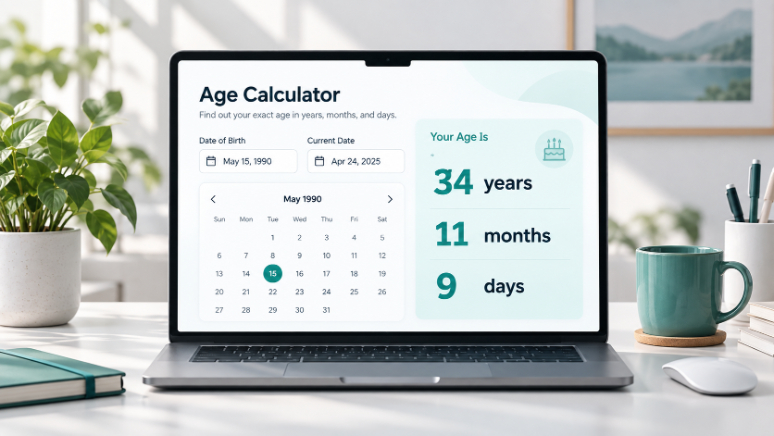
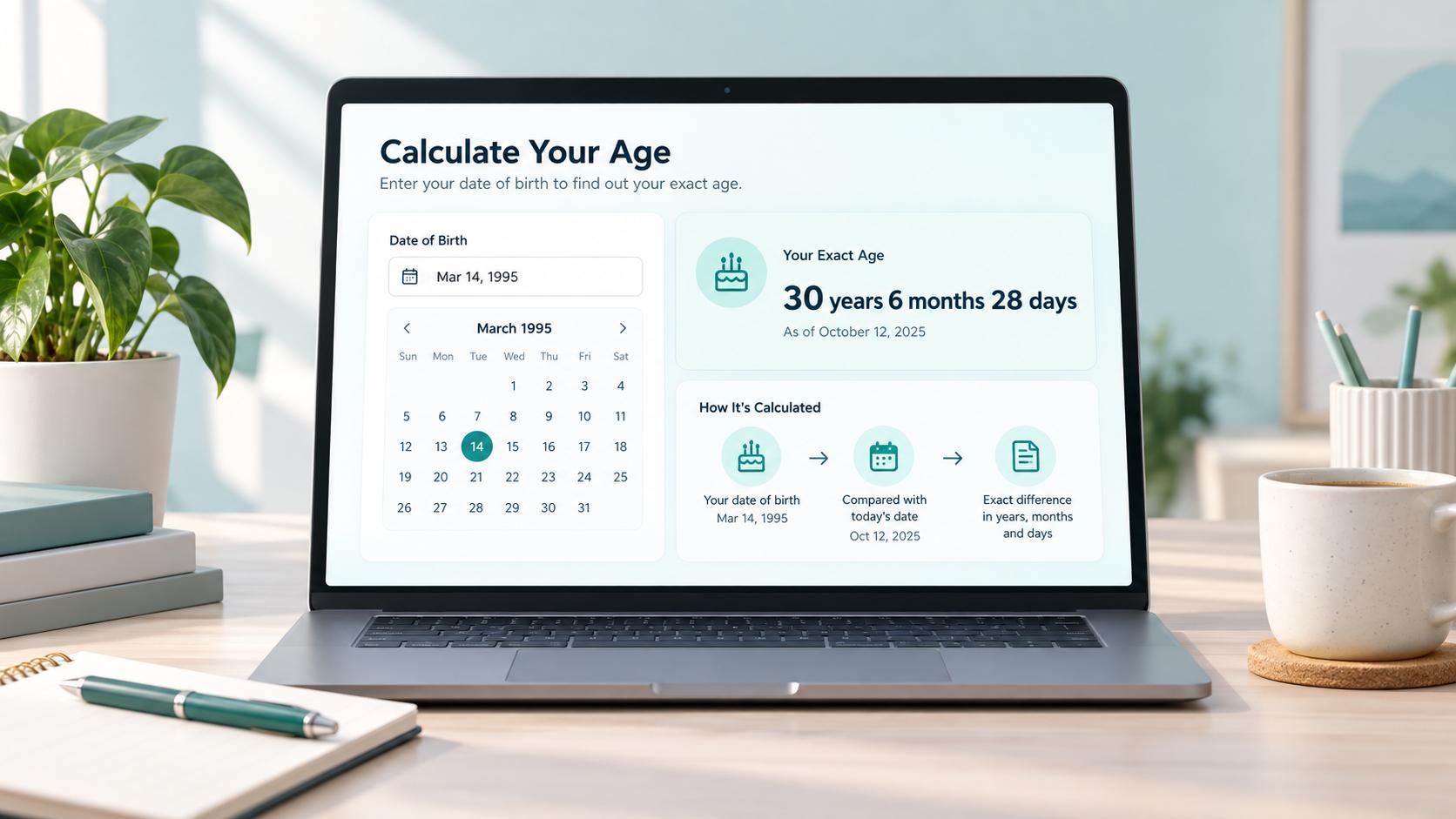
Age Calculator
Calculate your exact age in years, months, and days.
Can You Calculate Your Exact Age Using Excel?
Excel can be useful when you need to calculate ages for several people, such as students or employees.
Suppose cell A2 contains a valid date of birth.
To calculate completed years as of today, use:
=DATEDIF(A2,TODAY(),"Y")
For completed months after the last full year, use:
=DATEDIF(A2,TODAY(),"YM")
For remaining days after the completed months, use:
=DATEDIF(A2,TODAY(),"MD")
The DATEDIF function is convenient, but its "MD" option has documented limitations and can produce unexpected results for certain dates. Check unusual month-end and leap-day cases before relying on the result.
For official records, verify the calculation against the organization's required age convention.
Common Mistakes to Avoid When Calculating Your Age
Even a small date error can change the result.
Using only the birth year: This may overstate your completed age by one year if your birthday has not arrived.
Mixing date formats: A date written as 05/06/2000 could mean May 6 or June 5, depending on the country.
Treating every month as equal: Calendar months have different lengths, so assuming 30 days for each month can produce an inaccurate answer.
Ignoring the target date: Your age today may differ from your age on an application deadline.
Overlooking leap years: Extra days matter when calculating the total time elapsed.
Checking these details helps prevent errors, especially when exact dates are important.
When Is Knowing Your Exact Age Useful?
Exact age calculations are useful in more situations than birthday celebrations.
Educational institutions sometimes use a specific cutoff date to determine whether a student meets an admission requirement.
Sports organizations may divide participants into age categories based on their ages at a particular point in the year.
Medical professionals may also need precise ages, especially when working with infants and young children.
For employment, insurance, retirement planning, and government applications, age requirements can depend on completed years or a specified reference date.
In each situation, the important question is not simply how old someone is today, but which age calculation the relevant organization requires.
Frequently Asked Questions
How can I calculate my exact age without a calculator?
Write down your birth date and target date. Count completed birthday anniversaries first, then calculate the additional complete months and remaining days.
Why is my age different when calculated using only the year?
Subtracting birth years ignores whether your birthday has occurred. If your birthday is still approaching, the simple subtraction gives a result one year too high.
Can I find my age on a date in the future?
Yes. Choose the future date as your reference point and calculate the time between that date and your birth date.
Does my age increase on January 1?
No. Under the usual completed-age system, your age increases on your birthday, not automatically at the beginning of a calendar year.
Is an online age calculator always accurate?
A well-designed calculator can provide reliable results, but accuracy depends on its date-handling rules. Month-end birthdays, February 29, and legal age conventions may require special attention.
What is the difference between completed age and exact age?
Completed age usually refers to full years lived. Exact calendar age can also include the additional months and days since the most recent birthday.
Final Thoughts
Calculating your exact age begins with understanding the difference between a birth year and a complete birth date.
For a quick answer, checking the number of completed birthdays may be enough. When you need greater detail, counting the additional calendar months and days provides a clearer picture of the time that has passed.
Whether you calculate your age manually, use a spreadsheet, or rely on an online calculator, always confirm the birth date and the date on which the calculation is based.
A careful approach makes the result more dependable and helps you enter the correct age whenever accuracy matters.